
mercredi, février 28, 2007
Unbelievable !!!!!!!!
Click here to discover what a Belgian family hides behind the façade of their house! It's simply incredible! Although I feel sorry because the report is in French and filmed by the French television, I could resist! Serge has got 30 children from three different women: 2 of them (his wife and his sister in-law) live in his house and the third one has to live somewhere else because of a lack of room. Both parents are unemployed and they manage to feed their kids with only 3000 € a month! When they go shopping they need 170 lbs of potatoes, 9 lbs of pastas, 7 bottles/day of milk! It's just crazy! They live in a trhee-room house where the bedrooms look more like dorms than real kids' bedrooms!

mardi, février 27, 2007


mercredi, février 21, 2007
License plates

In the US, your are not forced to have a license plate at the front of your car, and you can even choose what's gonna be written on it! Isn't that amazing?! For instance, the owner of this Mini Cooper S picked "DI MINI" standing for "THE MINI"...Easy to remember! I've seen other funny stuff and even a little cheesy sometimes such as "V loves M"...Others even put names of sports like "GOLF"...Interesting! At the front, it is often seen that the owner put his/her favorite baseball or football team as his/her license plate! Much more excinting than our boring red numbers!
dimanche, février 18, 2007
Fuck Iraq, hot topic!

Paola and I saw this car with the American Flag and "fuck Iraq" written on it! Americans don't fear anything obviously!
Notre-Dame de Namur
 Notre Dame de Namur, that's the name of a university located in California! Can you believe that? Impressive, right?! Namur is the first city in the Waloon Region...
dimanche, février 04, 2007
Let's save up!
 I don't remember for what poroduct it was, but there is one thing I perfectly remember: these Americans are crazy! On this item, you could save 4 cents. I can't believe it! That's how they can get so rich! They keep saving up...And 4 cents in one shot, that's really impressive!
So, I really don't understand why Belgians keep complaining when we offer them discounts going up to 50%! OK...here there isn't any "sales time", but still! I'd rather save a lot at a time then saving 4 ridiculous cents everytime I go to buy a new pair of shoes!
I don't remember for what poroduct it was, but there is one thing I perfectly remember: these Americans are crazy! On this item, you could save 4 cents. I can't believe it! That's how they can get so rich! They keep saving up...And 4 cents in one shot, that's really impressive!
So, I really don't understand why Belgians keep complaining when we offer them discounts going up to 50%! OK...here there isn't any "sales time", but still! I'd rather save a lot at a time then saving 4 ridiculous cents everytime I go to buy a new pair of shoes!
samedi, janvier 27, 2007
On la connaissait....
Un homme se balade dans Central Park à New York. Soudain, il voit un pitbull attaquer une petite fille. Il se précipite, attrape le chien et finit par le tuer, sauvant ainsi la gamine. Un policier qui a vu la scène arrive et lui dit :
- "Vous êtes un héros. Demain, tout le monde pourra lire à la une des journaux : " Un courageux New-yorkais sauve la vie d'une enfant."
L'homme répond : - "Mais ... je ne suis pas de New York !"
Eh bien on lira : "Un courageux Américain sauve une petite fille... "
"Mais... je ne suis pas Américain !"
"Et qu'est ce que vous êtes alors ?"
"Je suis Pakistanais."
Le lendemain, les journaux titraient : " Un extrémiste islamiste massacre un chien américain sous les yeux horrifiés d'une petite fille. "

dimanche, janvier 07, 2007
Dick Cheney's research on Google

I hope you can actually read (click on the image to see it bigger) the words that Cheney looked up, but here are some of them: "jeanette mcdonald nude", "ossama ben laden", "lesbos vinyl black boots",...
INTERESTING what the vice president of the US looks for!
But don't worry I'm not suddenly becoming anti-republican!
Viewers fooled by 'Belgium split'
Belgians reacted with widespread alarm to news that their country had been split in two - before finding out they had been spoofed.
The Belgian public television station RTBF ran a bogus report saying the Dutch-speaking half of the nation had declared independence.
Later it said Wednesday night's programme was meant to stir up debate.
It appears to have succeeded. Thousands of people made panicked calls to the station and politicians complained.
"It's very bad Orson Welles, in very poor taste," said a spokesman for Prime Minister Guy Verhofstadt, referring to the famous director's 1938 radio adaptation of War of the Worlds. That spoof fooled many Americans into believing Martians had invaded.
"In the current context, it's irresponsible for a public television channel to announce the end of Belgium as a reality presented by genuine journalists," he added.
The French-language TV channel interrupted regular programming with an apparent news report, announcing that Dutch-speaking Flanders had unilaterally declared independence and that Belgium as a nation had ceased to exist.
It showed "live" pictures of cheering crowds holding the Flemish flag, huge traffic jams leading to Brussels airport, and trams stuck at the new "border".
The broadcast came amid an apparent growth of separatist sentiment in Flanders.
Recent regional elections have shown strong support for the far-right, nationalist Vlaams Belang party, which advocates Flemish independence.
The station's website crashed briefly as alarmed viewers sought more information, and 2,600 calls were made to a telephone number given out during the spoof. "Our intention was to show Belgian viewers the intensity of the issue of the future of Belgium and the real possibility of Belgium no longer being a country in a few months," Yves Thiran, head of news at RTBF, told the BBC.
He said it introduced people to the debate who would otherwise have ignored it, but he admitted some may have taken it the wrong way.
"We obviously scared many people - maybe more than we expected," he said.
Diplomatic reaction
Some politicians were in on the joke, contributing interviews to the programme with their reactions to the "news". But others were not amused.
The minister for audiovisual affairs for the French-speaking community, Fadila Laanan, said the words "this is fiction" appeared on screen half an hour into the broadcast - at her insistence.
"I find it questionable to use such a tactic, which frightened people unbelievably," she said, adding that a number of people had called her in panic when the "news" broke.
The AFP news agency reported that even some foreign ambassadors in Brussels were taken in, and sent urgent messages back to their respective capitals.


dimanche, novembre 26, 2006
The Belgian divisions in Communities and Regions

The country's constitution was revised on 14 July 1993 to create a unique federal state, based on three levels:
The federal government, based in Brussels.
The three language communities:
the Flemish (i.e., Dutch-speaking) Community;
the French (i.e., French-speaking) Community;
the German-speaking Community.
The three regions (which differ from the language communities with respect to the German-speaking community and the Brussels region):
the Flemish region;
the Walloon Region; and
the Brussels-Capital Region.
Conflicts between the bodies are resolved by the Court of Arbitration. The setup allows a compromise so distinctly different cultures can live together peacefully.
The Flemish Community absorbed the Flemish Region in 1980 to form the government of Flanders. The overlapping boundaries of the Regions and Communities have created two notable peculiarities: the territory of the Brussels-Capital Region is included in both Flemish and French Communities, and the territory of the German-speaking Community lies wholly within the Walloon Region. Flemish and Walloon regions are furthermore subdivided in administrative entities, the provinces.
At the highest level of this three-tiered setup is the federal government which manages foreign affairs, development aid, defence, military, police, economic management, social welfare, social security transport, energy, telecommunications, and scientific research, limited competencies in education and culture, and the supervision of taxation by regional authorities. The federal government controls more than 90 per cent of all taxation. The community governments are responsible for the promotion of language, culture and education in mostly schools, libraries and theatres. The third tier is the Regional governments, who manage mostly land and property based issues such as housing, transportation etc. For example, the building permit for a school building in Brussels belonging to the public school system would be regulated by the regional government of Brussels. However, the school as an institution would fall under the regulations of the Flemish government if the primary language of teaching is Dutch, but under the French Community government if the primary language is French.
The American divisions in States
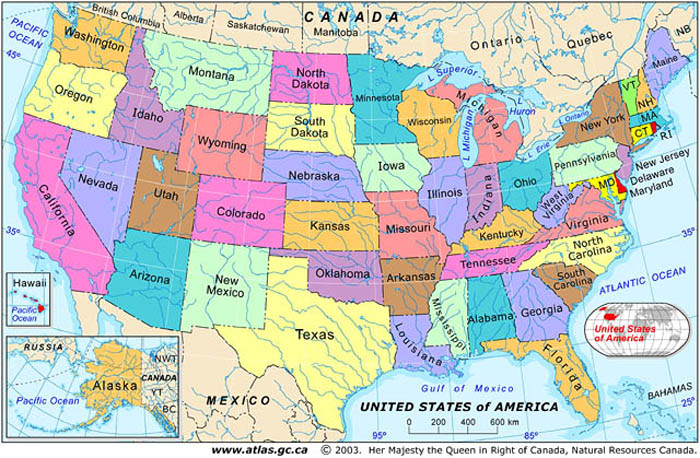
The contermi
-nous, or contiguous, forty-eight states—all the states but Alaska and Hawaii—are also called the continental United States. Some include Alaska in the "continental" states, because, although it is separated from the "lower forty-eight" by Canada, it is part of the North American mainland. All of these terms commonly include the District of Columbia. Hawaii, the fiftieth state, occupies an archipelago in the Pacific Ocean.
The United States also holds several other territories, districts, and possessions, notably the federal district of the District of Columbia—which contains the nation's capital city, Washington—and several overseas insular areas, the most significant of which are American Samoa, Guam, the Northern Mariana Islands, Puerto Rico, and the United States Virgin Islands. Palmyra Atoll is the United States' only incorporated territory; but it is unorganized and uninhabited. The United States Minor Outlying Islands consist of uninhabited islands and atolls in the Pacific and Caribbean Sea. In addition, since 1898, the United States Navy has leased an extensive naval base at Guantanamo Bay, Cuba.
Former U.S. possessions include the Panama Canal Zone, which was a U.S. territory from 1903 until 1979. Additionally, the Philippine Islands were American territory from 1898 until 1935, when the United States established the Commonwealth of the Philippines as a transition between territorial status and full Philippine independence, which occurred in 1946. Because it was part of the United States at the time of World War II, the Philippines is the only independent nation with a memorial pillar at the National World War II Memorial in Washington, DC.
In addition to the actual states and territories of the United States, there are also nations which are associated states of the U.S. The Federated States of Micronesia (since 1986), Palau (since 1994), and the Marshall Islands (since 1986) are associated with the United States under what is known as the Compact of Free Association, giving the states international sovereignty and ultimate control over their territory. However, the governments of those areas have agreed to allow the United States to provide defense and financial assistance. The U.S. also treats these nations uniquely by giving them access to many U.S. domestic programs, including disaster response and recovery and hazard mitigation programs under FEMA. The freely associated states are all dependent on U.S. financial assistance to meet both government operational and capital needs. The Office of Insular Affairs administers this financial assistance. The freely associated states also actively participate in all Office of Insular Affairs technical assistance activities. Together with the Commonwealth of the Northern Mariana Islands, each of these associated states were once part of the U.S.-administered UN Trust Territory of the Pacific Islands, which existed from 1947 until 1986 in the case of the Marshall Islands, the Northern Marianas, and the Federated States of Micronesia; Palau's trusteeship ended in 1994.
The Belgian Flag

The national flag of Belgium contains three equal vertical bands of black (hoist side), yellow, and red; the vertical design was based on the flag of France, whereas the colours were taken from the colours of the duchy of Brabant. When riots were starting as result of the Belgian revolution against the Dutch domination, a civil guard was established which wore the colours of Brabant. Its unusual proportions (13:15) are of unknown origin.
The flag was adopted January 23, 1831, soon after the Belgians gained their independence from the Netherlands in 1830. The flag had played an important role during the revolt, where the colours of the flag served as a reminder of an older flag with horizontal bands used during a previous revolt in 1789 in the then Austrian Netherlands. The original flag was with horizontal bars, but it was changed to vertical because of the resemblance with the flag of the Netherlands.
The American Flag

The flag of the United States consists of 13 equal horizontal stripes of red (top and bottom) alternating with white, with a blue rectangle in the canton bearing 50 small, white, five-pointed stars arranged in nine offset horizontal rows of six stars (top and bottom) alternating with rows of five stars. The 50 stars on the flag represent the 50 U.S. states and the 13 stripes represent the original Thirteen Colonies that rebelled against the British crown and became the first states in the Union. Nicknames for the flag include "the Stars and Stripes" or "Old Glory" with the latter nickname coined by Captain William Driver, a 19th-century shipmaster.
Inscription à :
Articles (Atom)
.JPG)